

HANDS-FREE
TICKETING
Beyond Tap,
Just Walk Through.
Visit us at
BOOTH #2212
WORLD’S FIRST COMMERCIALLY DEPLOYED ON BOTH METRO AND BUS LIVE IN SEOUL
-
BLE
Broad, reliable detection -
UWB
Precise positioning -
Vision AI
Behavior classification
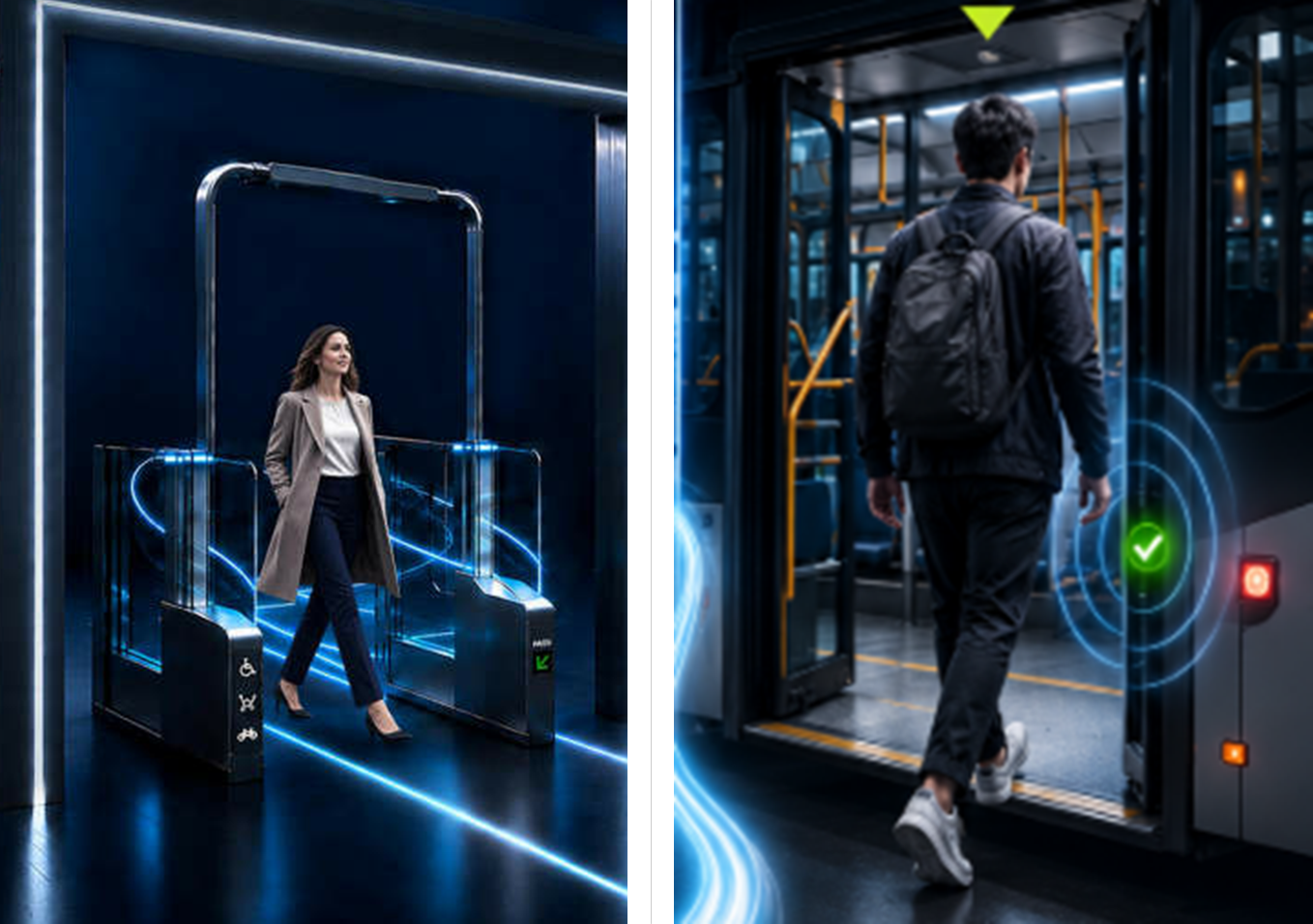
Tagless is the world’s first hands-free fare collection solution commercially deployed on both metro and bus. Its live operation in Seoul demonstrates
that the technology is commercially proven across different transit modes, infrastructure configurations and real-world operating conditions.
Tagless combines BLE, UWB and Vision AI within one integrated hands-free fare collection service. BLE supports broad, reliable detection in high-density
environments, UWB enables precise positioning for complex real-world edge cases, and Vision AI adds AI-powered behavior classification for enhanced
operational control. The technologies can be selectively applied and combined according to each operating environment.
 BLE
Vision AI
UWB
TAGLESS · A PROVEN DEPLOYMENT FOOTPRINT
LIVE ACROSS BUSES AND METRO IN THE SEOUL METROPOLITAN AREA
Commercially proven in everyday operation across different transit modes, infrastructure configurations and real-world environments.
BUS
36 ROUTES
600+ BUSES
METRO
130+ STATIONS
Seoul Metro Line 9 · Incheon Metro Line · UI-Sinseol LRT
Case Study
UI-Sinseol Case Study : A little but real change for everyone’s everyday life
The Problem
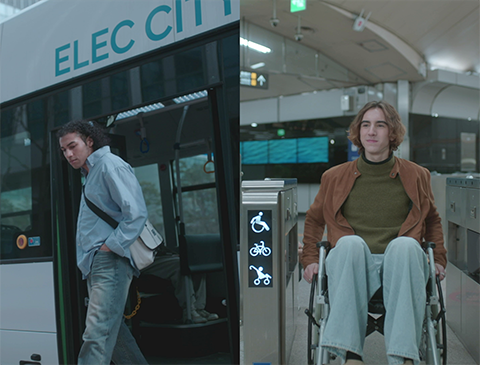
UI-dong in Seoul is an old bed town located about 10km away from the CBD(Central Business District), which has not yet been redeveloped, so the population and ridership are not high, but the UI-Sinseol line, a light rail line, was opened to improve infrastructure in 2017. As an old residential area with a high proportion of elderly people and a large number of office workers who commute to the city center at a relatively reasonable housing cost, there were two difficult challenges : a large variance in traffic during peak hours and off-peak hours, and consideration for the mobility handicapped by the age. It was also necessary to minimize investment costs given the relatively low ridership.
The Rationale
Tmoney has been responsible for transportation in Korea as a transit ticketing system supplier, operator and dominant transportation card issuer and settlement business provider for public transportation and taxis in metropolitan areas and major cities in Korea, with a population of 10 million and 40 million transactions per day from 2004 to the present. It has been the fastest to commercialize the latest trends in payment technology. From inter-operable nationwide transportation prepaid and credit/debit cards in 2004 to SE-based mobile payment in 2010 and HCE-based mobile payment in 2018, and after 5 years of researching and developing, Tmoney released Tagless adopting BIBO concept for the next generation ticketing solution, which is even more innovative and convenient.
System Delivered
Front-End
- Antenna
- BLE
- IR Sensor
- Flap Control
- User Position Tracking
Back-End
- Virtual Terminal Management
- Fare Calculation Logic
- Payment Method Management
- Transaction History Management
- Fare Policy Management
Application
- User Info Management
- User Device Management
- Application Management
- Customer Service
- Top-up / Payment
- Ride History
- Payment History
- User device’s sensor management
The Benefits
- Improved accessibility/usability of public transportation for the mobility handicapped
- Congestion relief by improved flow within unit time
- Integration with existing infrastructure minimizing additional investment costs
Project Statistics
13
Number of installed gates in UI-Sinseol line
99.9%
Accuracy rate
10K
Registered users
20%
Improved flow speed
The Results
- The world’s first commercialized non-honor based BIBO transportation ticketing system preventing fare evasion
- Confirmed Expansion to major cities such as Seoul, Incheon and Daejeon
- Recognized technology by both users and operators (Patented)
- Successful Implementation with minimal additional cost on current infrastructure
- Awarded by UITP and Transport Ticketing Global in the last two consecutive years (2023, 2024)
Lessons Learned
- Considering that the Seoul Metropolitan Metro, with 647 stations and a total length of 1,338 kilometers, has a unified fare plan, Tagless must support the combined use of NFC payment as well in a single trip chain. Therefore, instead of a separate new app service, Tmoney added a Tagless function to the existing NFC transportation payment app of 2.6 million MAU nationwide to enable both modes of payment.
- There have been cases of crashes on Bluetooth and device OS below a certain version. So Tmoney set the download requirements in the app market to AOS 8.0 and Bluetooth 5.0 or higher.
- Due to the rapid increase in congestion during peak hours, there have been cases of failure to enter the ready status or lost transactions. Therefore, Tmoney developed an antenna that allows fine-grained adjustment of BLE signal strength and applied it to adjust the signal strength remotely in real time.
- There are cases of network or Bluetooth malfunctions and app crashes during Tagless transactions due to conflicts with other apps installed on the user’s smartphone, shaded areas etc., In this case, adding a record to the transaction and forwarding it to the server, Tagless completes the transaction once the user's device is resumed in normal status for the transaction data integrity.
Incheon Metro Line 1&2 Case Study : Complete Freedom of Movement for a Gateway City of 3 Millions - the Era of Tagless Across All Incheon Metro Lines
The Problem
Incheon Metropolitan City is Korea's third-largest city with a population of 3 million — and by working-age and economically active
population, it has already overtaken Busan to become the nation's second-largest economic hub. It is home to national core infrastructure: Incheon
International Airport (3rd worldwide in international passengers by ACI, and Korea's primary gateway), the Port of Incheon (Korea's second-largest
container port), and the Songdo International Business District (IFEZ). Incheon is a self-contained international city where both work and daily
life are completed within its own boundaries.
For such a city, its urban rail is far more than a commuting tool. It is the artery of the city economy — connecting the port, the international
business district, and the old and new downtowns — and the space through which hundreds of thousands of citizens move every day. Yet the conventional
tap-based card system imposed friction unworthy of Incheon's stature.
- Mass transfer and through-traffic demand: During rush hours, as Lines 1 and 2 traverse the entire city, the brief act of pulling out and tapping a card became a bottleneck holding back countless citizens.
- Symbolic significance for an international city: In districts frequented by international visitors — such as Songdo International Business District and the areas serving Incheon International Airport — demonstrating Tagless, walk-through gate passage carried symbolic weight in itself, showcasing the caliber of Korean transport technology to the world.
- Freedom of movement for the entire city: A pilot limited to a handful of stations would confine the 'freedom of movement' — which every citizen deserves anywhere — to the privilege of a few sections.
What Incheon needed was not partial convenience improvements, but a complete transformation turning the entire urban rail network into a single Tagless zone.
The Rationale
For 20 years since 2004, Tmoney has been the developer, supplier, and operator of transit payment systems for the Seoul metropolitan area
and major Korean cities — serving a population of 10 million and processing 40 million transactions daily — as well as the issuer of the nation's
leading transit card and its integrated settlement provider. From the new transit card in 2004, to SE-based mobile payment in 2010, to HCE-based
mobile payment in 2018, Tmoney has been the fastest to commercialize every new trend in payment technology.
In particular, in September 2023, Tmoney commercialized the world's first non-honor-based BIBO (Be-In-Be-Out) Tagless system on the Ui-Sinseol
Line — winning the UITP and Transport Ticketing Global awards in consecutive years. This technology and operational know-how is an asset held by
Tmoney alone.
For the Incheon project, Tmoney had to scale its operational experience from a 13-gate light rail into a full heavy-rail deployment across 68
stations and 85 gates. This was not a mere increase in quantity.
- Field-customized design capability to absorb station-by-station differences in structure, gate width, gate layout, passenger flow, and radio environments
- Integration capability to run two infrastructure generations — Line 1 (opened 1999) and Line 2 (opened 2016) — in hybrid coexistence with the existing RF card payment system
- The capability to graft the entire Tagless system onto Incheon Transit Corporation's existing operations, settlement, and customer-service frameworks and make it work seamlessly in the field — a domain impossible without real commercial operating experience from the Ui-Sinseol Line, and a proven know-how unique to Tmoney.
Tmoney was the only provider simultaneously equipped with proven technology, real commercial operating experience, and the nationwide integrated settlement infrastructure.
Solution Requirements
Commercializing Tagless across an entire city's rail network required the following key requirements to be met.
- (Scale) Scalability: From 13 light-rail gates (Ui-Sinseol) to 85 heavy-rail gates — stable operation despite a 6x infrastructure expansion and the high-density usage environment unique to heavy rail
- (Accuracy) Gate matching: Precise matching of users to gates even in congested situations where many passengers enter adjacent gates simultaneously
- (Environment) Field adaptability: Station-level fine tuning and a remote operations system to handle differing radio environments and structures
- (Compatibility) Versatility: Hybrid coexistence with the existing RF card payment infrastructure, with minimal conversion cost
- (Reliability) Data integrity: Guaranteed transaction completion with zero loss even amid network failures or app crashes
System Delivered
Front-End
- Antenna Improved
- Clearer entry/exit direction determination through enhanced directivity detection
- BLE Improved
- Improved signal reception rate through focused transmission
- IR Sensor
- Flap Control
- User Position Tracking
Server-Based Payment Technology
- Virtual Fare Terminal Management
- Fare Calculation Engine
- Payment Method Management
- Transaction History Management
- Integrated Payment & Fault Monitoring
Application
- User Info Management
- User Device Management
- Application Management
- Customer Service
- Top-up / Payment
- Ride & Payment History
- User Device's Sensor Processing
The Benefits
With Tagless, Incheon's urban rail was redefined — from a 'payment infrastructure' to a 'mobility experience.'
- Freedom of movement, extended citywide: Citizens enjoy the identical Tagless experience no matter which station they enter. Complete coverage without station-by-station disparity is the precondition of true freedom of movement.
- A first impression worthy of an international city: For domestic and international visitors traveling between Songdo and the airport, the 'no-tap payment' they experience on Incheon's metro became a symbolic scene extending the smart-city image across the entire urban rail network.
- Structural relief of congestion: Improved gate throughput per unit time eased rush-hour bottlenecks and reduced the mobility burden on the transport-vulnerable.
- Maximum transformation at minimal cost: Hybrid construction on the existing RF infrastructure minimized additional investment despite full-network conversion, setting a milestone for investment-efficient large-scale commercialization.
Project Statistics
68
Stations
(entire Lines 1 & 2)
85
Gates
(entire Lines 1 & 2)
238,041
Cumulative transactions
(as of August 2026)
9,550
Daily average
(on weekdays)
3,740
Daily average
(on weekends)
11,000
per weekly
(in September 2026)
The Results
"Korea's first citywide Tagless commercialization — the end of pilots, the beginning of the commercial era"
- The Incheon Metro project is Korea's first case proving that Tagless is a universal commercial service that can scale beyond 'pilot service at select stations' to an entire urban rail network.
- Tagless, proven on a light rail (Ui-Sinseol), was expanded to an entire heavy-rail network, verifying stability and scalability — maintaining transaction accuracy above 99% and stable operation across a large-scale environment of 68 stations and 85 gates.
- Incheon citizens now enjoy complete freedom of movement without taking out a card as part of daily life, and Incheon became the first city in Korea where 'the entire city is a Tagless zone.'
Lessons Learned
- Proving large-scale commercialization: Together with Incheon Transit Corporation, Tmoney built Tagless infrastructure across 71 stations (85 gates) on Lines 1 & 2, successfully operating the first large-scale Tagless service linking an entire urban rail network among Korean metropolitan areas. This confirmed that Tagless technology is a commercial service that can expand beyond station-level pilots to entire urban rail systems.
- A remote operations system absorbing station-by-station differences: Operating 71 stations and 85 gates simultaneously revealed that station structures, gate widths, layouts, foot traffic, and radio environments all differ, making uniform equipment settings insufficient for stable service. Tmoney therefore segmented BLE signal strength and recognition range by field environment, and built an operating framework enabling remote monitoring and real-time configuration adjustment.
- Precise user-gate matching under congestion: Under high rush-hour congestion with many users entering simultaneously, the technology to accurately match users to gates determined service quality. By comprehensively using BLE signals, smartphone sensors, and gate detection data, Tmoney determined entry direction and passage timing, and continuously improved to minimize misreads and interference between adjacent gates.
- Integrated variable management and fault response: In large-scale commercial service, success rates alone are not enough — diverse variables must be managed together: app state, smartphone model, Bluetooth and location settings, and network conditions. Incidents were analyzed by type, and improvements were made by linking the app, the center, and field infrastructure — shortening fault response times and raising service stability.
Seoul Bus Case Study : Among Gates That Move - and Move Together : Hands-Free Bus Payment at the World's Highest Difficulty
The Problem
If metro Tagless presumes a 'fixed gate,' bus Tagless is a challenge where that very premise does not hold. Unlike the metro, where gates
and their surroundings are fixed, a bus moves on its own with its payment terminal onboard, stopping in different road environments at different
positions every time. When the space that serves as the basis for recognition itself moves, ensuring accuracy and stability requires know-how and
deliberation of a different dimension.
And in Seoul, this 'moving gate' does not exist alone. Tagless buses stop side by side at the same stop, and overtake and cross each other while in
service. In other words, in an environment where multiple moving gates interact in combination, the system must go beyond 'inside a bus or not' to
distinguish 'inside which bus.' The moment a passenger of the adjacent vehicle is misread as one's own, the fare and the entire transfer chain go
wrong.
- The world's most difficult operating environment: In the global megacity of Seoul, buses run on narrow, complex roads carrying the most passengers. The radio environment inside and outside the vehicle changes constantly, and in busy districts such as Hongdae, Myeongdong, and Gangnam, Bluetooth signal interference is severe. For hands-free payment deployment, this amounts to the highest difficulty in the world.
- Simultaneous respect for free boarding and an innovative transfer fare system: Seoul buses allow boarding through both front and rear doors, operating on a world-renowned integrated transfer fare system covering metro-bus, bus-bus, and bus-metro transfers. Tagless had to honor this system exactly as-is while recognizing both boarding and alighting to complete the transfer trip chain quickly and accurately. If alighting recognition is delayed, the transfer discount breaks; if door classification is wrong, the fare is wrong.
- Buses that cannot stop at the stop: In Seoul, it is routine for buses to be unable to stop right next to the stop due to rush-hour congestion or roadworks. Similar solutions premised on 'a bus that has arrived at the stop' cannot handle this reality. Bus Tagless must precisely single out only the passengers inside the vehicle — a problem of a different dimension.
- The problem between 'the moment of boarding' and 'the moment of alighting': For a metro gate, recognition is entirely an instantaneous judgment of 'did you pass the gate.' A bus is different. Long dwell times onboard during signal waits, road congestion, and transfer waits, plus movement between window and aisle — unless the system continuously verifies that the passenger remains onboard throughout the entire interval between boarding and alighting, merely passing through a congested section can be misread as 'alighting,' causing unintended alighting transactions and fare errors. Bus Tagless had to be designed not for a momentary judgment, but for continuous onboard verification across the entire journey.
What Seoul buses needed was not a 'transplant of metro Tagless,' but an entirely new recognition architecture that tracks the whole boarding process among multiple moving spaces.
The Rationale
For over 20 years since 2004, Tmoney has been the developer, supplier, and operator of transit payment systems for the Seoul metropolitan
area and major Korean cities — serving 10 million people and 40 million daily transactions — as well as the leading transit card issuer and integrated
settlement provider. Seoul's integrated transfer fare system has run on Tmoney's payment and settlement infrastructure for over two decades, and the
only provider able to overlay a new payment method without breaking that system is Tmoney, its designer and operator.
Technologically, too, Tmoney was the only choice.
- From the world's first commercial non-honor-based BIBO Tagless on the Ui-Sinseol Line (2023) to full heavy-rail-scale commercial operation across Incheon Metro Lines 1 & 2 (2024) — the world's longest and largest track record of operating Tagless in fixed-gate environments
- Upgrading the accumulated capabilities of fine-grained BLE signal control, remote real-time adjustment, and user position tracking from 'fixed gates' to 'moving vehicles' — and further to 'roads where multiple vehicles cross' — is a domain only a provider that has itself operated two commercial deployments can attempt.
- The capability to implement bus-specific fare policies and operating rules in code — front/rear door classification, vehicle-to-vehicle distinction, onboard verification, transfer trip-chain completion, and free-riding detection — is likewise a unique asset of Tmoney, the designer and settlement provider of Seoul's bus fare system.
Tmoney was the only provider simultaneously equipped with proven technology, real commercial operating experience, and the nationwide integrated settlement infrastructure.
Solution Requirements
Tagless on moving buses required key requirements distinct from those of the metro.
- (Space) Adapting to moving environments: Consistent recognition accuracy and stability even as terminals move with vehicles and stopping positions vary each time
- (Identification) Vehicle-to-vehicle distinction: In composite environments where Tagless buses stop side by side and cross each other, precisely identify 'the bus' the passenger is aboard and block confusion with passengers of adjacent vehicles
- (Separation) Inside/outside vehicle determination: Exclude 'users outside the vehicle' — pedestrians near stops, passengers of adjacent vehicles — and recognize only actual onboard passengers
- (Continuity) Onboard verification: Beyond instantaneous boarding/alighting judgments, continuously verify the passenger's presence onboard throughout the journey to prevent unintended alighting transactions
- (Direction) Front/rear door distinction: In free bidirectional boarding/alighting, precisely determine the boarding door and direction; prevent free-riding
- (Speed) Rapid trip-chain completion: Complete recognition instantly at boarding and within seconds at alighting so the transfer fare system operates without interruption
- (Robustness) Durability in extreme environments: Resilience spanning high/low cabin temperatures, downtown radio interference, and smartphones under multitasking
System Delivered
Front-End
- Antenna Improved
- Optimized beacon placement inside & outside the vehicle
- Position determination extended to nearby users outside the vehicle
- BLE Improved
- Location-based beacon signal separation and reception stabilization
- User Position Tracking Improved
- Determination of front/rear-door boarding position and vehicle approach
Server-Based Payment Technology
- Virtual Fare Terminal Management
- Fare Calculation Engine
- Payment Method Management
- Transaction History Management
- Fare Policy Management
- Boarding-Alighting Location Confirmation Improved
- Location data determined on the mobile device transmitted to the onboard terminal
Application
- User Info Management
- User Device Management
- Application Management
- Customer Service
- Top-up / Payment
- Ride & Payment History
- Mobile Location Determination Logic Improved
- Front/rear-door boarding determination by distinguishing beacon installation positions
- Improved accuracy in boarding-direction and free-ride detection
The Benefits
Seoul Bus Tagless introduced an experience that changes transit usage behavior itself, beyond 'unmanned payment.'
- Hands-free boarding and alighting as everyday life: Passengers carrying bags, on calls or watching videos, or with limited mobility all board and alight without taking out a card. In the narrow, crowded interior of a bus, the value of 'payment without taking anything out' exceeds even that of the metro.
- Full preservation of the innovative transfer system: Because alighting recognition and trip-chain completion happen automatically, passengers enjoy Seoul's integrated transfer fare benefits with no action at all. This is a case where technology evolved not to accommodate the fare system, but to protect it.
- Design reliability toward 'zero misreads': Vehicle distinction amid bus-crossing environments and the onboard-verification design structurally resolve the two chronic risks of hands-free bus payment — 'being recognized on someone else's bus' and 'being processed as alighted while still aboard.'
- Proof at the world's highest difficulty: Hands-free bus payment that works in Seoul becomes a technical reference applicable to buses in any city in the world.
- Validation of a phased expansion design: Operating Phase 1 at about 10% of the fleet secured empirical data establishing the technical and operational criteria for full-scale expansion.
Project Statistics
36
Routes
600
Vehicles
(truck&branch lines)
5,000+
Daily Transactions
(as of September 2026)
10
Seconds
(Alighting recognition speed)
The Results
"Commercializing gates that move in combination — hands-free universality proven at the world's highest difficulty"
- Seoul Bus Phase 1 is Korea's first commercial case expanding Tagless from 'fixed gates' to 'moving vehicles' — and further to environments of 'multiple moving vehicles crossing each other' — proving that non-honor-based hands-free payment can operate commercially without any fixed-infrastructure premise.
- Unlike gates where 'passage judgment' is everything, the continuous boarding-onboard-alighting verification design was commercialized, establishing the design standard for bus-type BIBO that structurally prevents unintended alighting transactions.
- While preserving free front/rear-door boarding and the complex transfer fare system exactly as they are, boarding/alighting recognition and trip-chain completion were realized — establishing the technical standard for hands-free payment coexisting with the fare system.
- Continuously operating stably in Seoul's bus environment — rated the world's most difficult — the project secured the technical and operational criteria for expanding across the entire Seoul bus fleet.
Lessons Learned
- Overcoming downtown radio interference: In major Seoul downtown areas (near Hongik University Station, Myeongdong Station, Gangnam Station, etc.), dense floating populations cause strong interference in the Bluetooth band. Tmoney applies a mobile Bluetooth signal determination logic to the live service, ensuring smooth boarding/alighting recognition even under signal interference.
- Vehicle-optimized antennas and durability design: To clearly separate inside and outside the vehicle, Tmoney developed and applied an antenna optimized for the vehicle environment, along with antenna technology unaffected by interior/exterior variations across diverse vehicle models. Considering the operating environment of vehicles running outdoors, the hardware uses materials that minimize physical property changes under high/low temperatures, and — in preparation for the growing adoption of electric vehicles and EV fire incidents — flame-retardant materials were applied.
- Seamless guarantee under multitasking: Developed so that boarding/alighting recognition and payment proceed even while users multitask on their phones — calls, games, YouTube — ensuring the boarding/alighting process remains seamless.
- Identification of moving gates and continuous-verification design: Unlike the metro, bus Tagless operates in environments where Tagless buses stop side by side at stops or cross each other in service. Vehicle-to-vehicle distinction technology — accurately identifying the vehicle a passenger is aboard and preventing confusion with passengers of adjacent vehicles — determined service quality. Also, unlike the metro, which completes with an instantaneous 'gate passage' judgment, buses required an onboard-verification logic that continuously confirms a passenger's presence during the ride, structurally preventing unintended alighting transactions caused by road congestion, signal waits, or onboard movement. This is design and operational know-how that can only be accumulated in mobile payment environments without fixed infrastructure.
Seoul Metro Line 9 Case Study : The World's Only Hands-Free Transfer, Completed on Seoul's Golden Line - Line 9, the Pinnacle of Tagless
The Problem
Light rail (Ui-Sinseol), an entire city network (Incheon Metro), and the moving gate (Seoul Bus) — Tagless had already been commercially
proven in three environments. The remaining task was clear: large-scale deployment at the apex of Korean transit demand, on the busiest golden
line in Seoul.
Seoul Metro Line 9 is called the 'Golden Line.' From Gimpo Airport through Magok, Noryangjin, and Yeouido, and on to Express Bus Terminal, Sinnonhyeon,
Gangnam, and Samseong (Bongeunsa), it pierces through Seoul's core business districts and the airport gateway in a single corridor. Peak congestion on
its express trains — where commuter demand concentrates — reaches 199%, a level beyond comparison not only with regular trains (128%) but with any
previous project. Line 9 is, quite literally, the heart of Seoul transit.
- The physical limits created by congestion: Wireless signals such as BLE are inherently absorbed by the human body and thus heavily affected by crowding. Rush-hour scenes at Line 9 express stations — where huge crowds surge toward the gates simultaneously — are the harshest test of Tagless recognition accuracy.
- An environment where 'passage' alone is not enough: Amid extreme congestion, gate-passage judgment alone cannot filter out misreads. Supplementary indicators were needed to determine where passengers are on platforms and along movement paths — whether they are approaching or passing through.
- The last missing link of transfer: Seoul's integrated transfer fare system freely connects bus-metro, metro-metro, and bus-bus trips, but Tagless existed separately on rail (Ui-Sinseol, Incheon) and buses (Seoul Bus) — with no transfer connecting the two. Even on Line 9, where Seoul's largest transfer demand concentrates, passengers rode the metro Tagless but had to pull out a card again when transferring to a bus.
- The symbolism of the Golden Line: It is the line through which domestic and international visitors enter via Gimpo Airport, and hundreds of thousands of workers commute to Yeouido and Gangnam every day. Tagless on this line means more than service expansion — the moment hands-free becomes the standard on the representative corridor of Korean public transit.
What Line 9 needed was not a simple transplant of proven technology, but a redesign of the recognition architecture to withstand Seoul's most congested environment — and the completion of transfer between bus and metro.
The Rationale
For over 20 years since 2004, Tmoney has been the developer, supplier, and operator of transit payment systems for the Seoul metropolitan
area — serving 10 million people and 40 million daily transactions — as well as the leading transit card issuer and integrated settlement provider.
Seoul's integrated transfer fare system runs on Tmoney's payment and settlement infrastructure, and completing a transfer trip chain between bus and
metro on top of that system is a domain possible only for Tmoney, its designer and operator.
The lineage of technical proof is also unique to Tmoney.
- Light rail: Ui-Sinseol Line (2023), the world's first commercial non-honor-based BIBO Tagless
- Entire city network: Incheon Metro Lines 1 & 2 (2024), large-scale commercial operation across all lines
- Bus: Seoul Bus Phase 1 (2025), commercialization in the moving-gate environment
- Only a provider holding commercial operating experience across all three environments can design — and actually operate — a Tagless transfer system spanning rail and bus on Seoul's most congested line.
- In particular, the capability to accumulate and improve from data the problems that only surface in large-scale commercial operation — the effect of congestion on signal recognition, station-by-station radio differences, handling multitasking smartphones — is a unique asset of Tmoney, which has directly operated three commercial deployments.
Solution Requirements
Commercializing Tagless on Seoul's most congested line required the following key requirements to be met.
- (Scale) High-density processing: Transaction volumes up to 3x those of Incheon's most congested station; stable, error-free processing of mass simultaneous gate passage at rush hour
- (Signal) Securing signals amid congestion: Recognition performance that overcomes BLE signal loss and interference even in extreme crowding, given the human body's absorption of wireless signals
- (Tracking) Supplementary movement-path judgment: Supplementary indicators to determine passengers' movement paths and entry/exit states across platforms and key corridors, beyond gate-passage judgment
- (Linkage) Bus-metro transfer completion: Connecting rail Tagless and bus Tagless into a single trip chain, preserving the integrity of the transfer fare system and the continuity of the hands-free experience
- (Expansion) Criteria for Seoul-wide rollout: Securing technical and operational criteria for expansion across Seoul's rail network as empirical data
System Delivered
Front-End
- Antenna Improved
- Enhanced directivity and reception sensitivity to withstand high-congestion environments
- BLE Improved
- Stabilized signal reception in ultra-congested environments conpensating for signal loss caused by human-body absorption
- Additional Beacon
- Supplementary determination of users' movement paths and entry/exit states via additional beacons installed on platforms and key corridors
- IR Sensor
- Flap Control
- User Position Tracking
Server-Based Payment Technology
- Virtual Fare Terminal Management
- Fare Calculation Engine
- Payment Method Management
- Transaction History Management
- Fare Policy Management
- Integrated Payment & Fault Monitoring Improved
- Real-time monitoring of load and anomalies under high-density simultaneous transaction processing
Application
- User Info Management
- User Device Management
- Application Management
- Customer Service
- Top-up / Payment
- Ride & Payment History
- User Device's Sensor Processing
- Mobile Processing Logic Improved
- Added judgment-deferral and recovery logic for signal-loss situations during peak congestion hours
The Benefits
Line 9 Tagless set a new standard for the hands-free experience at the center of Seoul transit.
- Hands-free as the standard on the Golden Line: From Gimpo Airport to Gangnam, movement without taking out a card became everyday life on Seoul's east-west core axis. Deployment on the busiest line is the strongest proof that 'Tagless works even in crowded places.'
- The world's only bus-metro Tagless transfer: Whether transferring from metro to bus or bus to metro, passengers need to do nothing at all. Non-honor-based hands-free transfer spanning rail and bus is a commercial service found nowhere else in the world.
- Evolution of recognition technology under congestion: Overcoming the physical limit of wireless signals (human-body absorption) through antenna performance improvements and supplementary beacons, errors in extremely congested environments were markedly reduced.
- A bridgehead for Seoul-wide expansion: Verifying scalability across Seoul's diverse transit environments — business districts (Yeouido), residential areas (Gayang), rush-hour express congestion — secured the technical and operational criteria for expansion to Seoul's entire rail network.
Project Statistics
25
Stations
(Line 9 Phase 1)
40
Gates
(Line 9 Phase 1)
208,853
Cumulative transactions
(as of August 2026)
8,550
Daily average
(on weekdays)
2,930
Daily average
(on weekends)
12,100
per weekly
(in September 2026)
The Results
"Commercializing the world's only bus-metro Tagless transfer — hands-free completeness proven on Seoul's most congested line"
- Seoul Metro Line 9 Phase 1 is the first subway line in Seoul to adopt Tagless, verifying the service's stable operability in a high-density, high-congestion environment where daily average transactions rival those of the entire Incheon region.
- With Line 9, Tagless on two different modes — rail (metro) and road (bus) — was connected into a single transfer trip chain: the world's only commercial hands-free bus-metro transfer service.
- Processing 1,300+ daily transactions in core areas such as Yeouido (business) and Gayang (residential), and handling up to 3x the volume of Incheon's most congested station, the project overcame the technical limits of Seoul's most congested environment.
- The project is a key bridgehead that secured the technical and operational criteria for expanding across Seoul's rail network — the foundation for the Tagless transformation of Seoul's entire public transit system.
Lessons Learned
- First adoption on a Seoul subway line; verification in high-density environments: Line 9 Phase 1 is the first subway line in Seoul to introduce Tagless — a high-density, high-congestion environment whose daily average transactions rival those of the entire Incheon region. This verified that Tagless can operate stably even in environments with massive ridership.
- Simultaneous-passage processing in ultra-congested environments: Business districts like Yeouido and residential areas like Gayang each generate 1,300+ daily Tagless transactions, with volumes up to three times those of Incheon's most congested station. Processing performance for congested environments was continuously improved so that the system operates stably and without payment errors even when many users pass the gates simultaneously at rush hour.
- Upgrading the recognition architecture to overcome congestion: To minimize BLE signal interference and adjacent-gate misreads driven by rising ridership and congestion, antenna directivity and reception performance were improved, and additional beacons were installed on platforms and key movement corridors to more accurately determine users' movement paths and entry states. Through this, errors occurring in the Tagless journey are being markedly reduced.
- Securing technical and operational criteria for Seoul-wide expansion: Operating experience on Line 9 Phase 1 verified Tagless scalability across Seoul's diverse transit environments — business districts, residential areas, and rush hours. This secured the technical and operational criteria for expanding Tagless across Seoul's entire rail network, establishing a key bridgehead for Tagless proliferation across Seoul.
- Post-hoc misread correction and data feedback: Even with perfect prevention, a small number of misreads can inevitably occur in ultra-congested environments. Tmoney therefore operates a post-hoc correction process that minimizes passenger inconvenience (objection intake → verification based on movement-path data → automatic fare correction), and built a virtuous improvement cycle that accumulates correction cases by type and feeds them back into recognition-logic improvements. The core lesson of Line 9 operations is that the trustworthiness of a commercial service is completed only when 'technology that reduces errors' and 'operations that take responsibility for errors' come together.